
Last updated on August 13th, 2026 at 07:12 pm
Last updated on August 13th, 2026 at 07:12 pm
HILL Model Framework: Treating Concussion Neuroinflammation with Low-Dose Lithium
Discover the latest in concussion prevention and recovery strategies. Learn about the HIll Model Framework for managing neuroinflammation with microdoses of Lithium.

HILL Model Framework: Low-Dose Lithium Breakthrough for Concussion Treatment
The HILL Model Framework and the Biology of Concussion

Low-Dose Lithium Breakthrough for Concussion Treatment and TBI
The HILL model framework (Head impact–inflammation–low-dose lithium) is a revolutionary emerging framework that connects Head impact mechanics and neuroinflammation to the neuroprotective properties of low-dose lithium. Recent data suggest that low-dose lithium safely dampens trauma-induced cytokine spikes (such as IL-6, IL-1β, and TNF-α) to improve recovery outcomes after traumatic brain injury (TBI). By targeting the complex biochemical cascade triggered by concussion, this novel approach works to preserve brain health, prevent cellular damage, and accelerate recovery. The HILL model framework offers a roadmap for moving from reactive symptom monitoring to proactive, mechanism-based brain protection. It isn’t just about treating a “hit”—it’s about managing the biological cascade that follows. Curious about how this could change the future of sports medicine, military readiness, and long-term brain health? Read Dr. Sudhir Gadh’s full peer-reviewed publication on Cell Trends Open.
Stop Waiting and Start Recovering: How the HILL Model Framework Targets the Biology of Concussion Neuroinflammation Using Low-Dose Lithium
For years, the standard approach to concussion treatment has been simple: stop, rest, and wait. While rest is a necessary first step, this “wait-and-see” mindset overlooks the hidden reality of traumatic brain injury (TBI): the brewing storm of neuroinflammation. For athletes, military personnel, and others exposed to repeated head impact, failing to address this inflammatory cascade leaves the brain dangerously susceptible to decreased cerebral edema and secondary lesions – threatening long-term cognitive decline. While the skull provides rigid external protection, neural tissue has not evolved to withstand the rapid acceleration and deceleration imposed through modern contact sports and military training and combat operations. Even impacts below the threshold of a diagnosed concussion can disrupt neuronal membranes and stretch axons. The HILL model framework also provides insights into how neuroinflammation can be modulated, fostering an understanding of the underlying biological processes involved in concussion recovery.
Rethinking Brain Injury, Prevention, and Recovery: The HILL Model for Concussion Recovery
By seeking new and innovative approaches, traditional treatment protocols are shifting from this traditional wait and see approach of managing head trauma as a static mechanical event to a more dynamic, observable, and actionable sequence of biological processes (observed and measured by inflammatory biomarkers) – offering authoritative potential to enact more comprehensive, versatile, and impactful diagnostic and treatment options. The HILL model enables this shift in perspective, showcasing head impacts as not merely mechanical events, but rather observable and modifiable biological processes. When a head impact occurs, it sets off a “domino effect” inside the brain. The dynamic nature of the HILL model framework allows for a proactive approach to concussion management, shifting the focus to biological processes rather than just mechanical impacts.

- Head Impact (H): Mechanical forces (acceleration and deceleration) cause shear stress on brain tissue, disrupting normal functioning of cell membranes and axons;
- Inflammation (I): This physical trauma acts as a trigger, causing the brain's immune cells (microglia and astrocytes) to become hyperactive, kick-starting an "inflammatory cascade"—a surge of cytokines that leads to secondary injury and energy crises in the brain.
- Low-Dose Lithium (LL): The Modulator - While lithium is historically associated with high-dose psychiatric use, low-dose (nutritional level) lithium acts differently. It can help "dampen" the inflammatory surge, stabilize mitochondria, protect neurons, and outright stop cell death by blocking an enzyme called GSK-3beta. It has proven effective in calming brain cells that cause inflammation while raising BDNF levels. BDNF helps brain cells make new connections and stay healthy. Increases in BDNF helps brain cells clear out old, broken proteins that can cause neurodegeneration and long-term harm.
Beyond symptoms: Neuroinflammation and the Biology of Concussion
Understanding the HILL model framework helps in grasping the complexities of concussion and the crucial role of low-dose lithium in mitigating neuroinflammation.
Concussion and repeated head-impact exposure represent one of the most consequential challenges in sports medicine, military readiness, and public health. Millions of athletes, both youth and adult, from American football players to professional fighters, are exposed yearly to biomechanical forces that the human brain did not evolve to withstand [1]. Subconcussive impacts can number in the hundreds or thousands per season for certain positions in American football [2]. These impacts, though clinically silent, initiate measurable neuroinflammatory cascades that may accumulate over time [3]. The burden of disease is enormous: chronic traumatic encephalopathy (CTE), persistent post-concussive syndrome, cognitive decline, neurodegenerative disease, chronic pain, sleep disturbance, emotional lability, functional impairment, and elevated risk of depression and suicide 1, 2. In this opinion article, we address whether neuroinflammatory responses to head impact can be quantitatively linked to mechanical exposure and safely modulated using low-dose lithium (LL). The HILL model framework is essential for understanding these neuroinflammatory cascades and their implications for overall brain health.
How Low-Dose Lithium Protects the Brain
With the HILL model framework in mind, the protective benefits of low-dose lithium can be better understood, leading to enhanced recovery strategies.
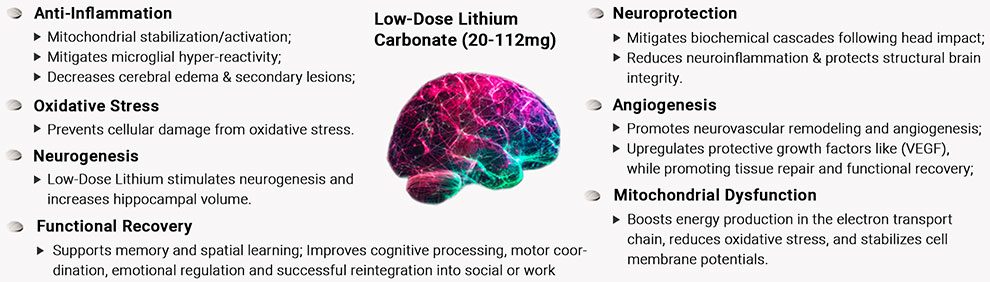
Low-Dose Lithium Carbonate (20-112mg) Serves as a Powerful Neuroprotective Agent by:
- Reducing Neuroinflammation: Helps mitigate microglial hyper-reactivity and decreases cerebral edema (swelling) and secondary lesions;
- Preventing Cellular Damage: It combats oxidative stress, stabilizes mitochondrial function, and maintains healthy cell membrane potential;
- Boosting Energy Production: It supports the electron transport chain, ensuring the brain has the energy required for tissue repair.

Promoting Structural & Functional Recovery
Beyond immediate protection, lithium carbonate supports long-term neurological resilience by:
- Stimulating Neurogenesis: It promotes hippocampal volume and supports brain structure;
- Encouraging Remodeling: It fosters neurovascular remodeling and angiogenesis (the formation of new blood vessels);
- Improving Quality of Life: Supports memory and spatial learning, improves cognitive processes, increases motor coordination, supports emotional regulation, and facilitates re-integration into social and professional roles.
By addressing the underlying damage from TBI, low-dose lithium may help improve:
- Cognitive processing, memory, and spatial learning;
- Motor coordination and emotional regulation;
- The ability to reintegrate successfully into social and work environments.
Lithium Inflammation Psychiatry (LIP) Study at the Karolinska Institute
Rigorous scientific research on concussion biomarkers and the cascade of neuroinflammation is imperative for fashioning novel approaches to head-impact treatment and recovery. Dr. Sudhir Gadh and researchers from the Karolinska Institute are actively seeking funding to expand on initial research findings pursuant to formalizing and operationalizing the HILL model as a systematic, actionable framework that integrates head impact mechanics, the inflammatory response, and the neuroprotective, regenerative effects of Low-dose lithium to mitigate brain injury, reduce neuronal damage, and improve short-term and long-term cognitive and motor outcomes while facilitating functional recovery, and significantly improving overall quality of life. By reframing concussion as a modifiable biological process rather than a static mechanical event, the HILL model framework offers a proactive, precision-based pathway for better recovery and long-term brain health.
What are Safe Doses of Lithium for Brain Health?
Many of lithium’s potentially beneficial effects occur at doses below traditional psychiatric ranges. Microdose or nutritional lithium, approximately 0.3–2 mg/day elemental, has shown measurable effects in reducing inflammatory markers, enhancing neuronal resilience, slowing cognitive decline in early Alzheimer’s studies, and reducing suicidality and violence in population studies of naturally occurring lithium exposure. The safety profile at these low doses appears favorable. Serum monitoring is generally not required at nutritional levels, renal and thyroid risks are far lower than with conventional psychiatric dosing, and lithium’s action more closely resembles a nutrient-modulator than a high-dose pharmaceutical.

Future Directions for Brain Health
The HILL model argues that the long-term consequences of head impacts do not have to be an inevitable fate. By integrating wearable sensors to track impact forces, measuring blood-based inflammatory biomarkers, and utilizing low-dose lithium, sports medicine and public health systems can shift from simply managing concussion symptoms to actively building brain resilience.
About the Lead Researcher: Dr. Sudhir Gadh
Dr. Sudhir Gadh is a New York City-based psychiatrist and an affiliate researcher at the Karolinska Institute in Sweden and the Galicia Sur Health Research Institute in Spain. With a background as a commander in the U.S. Navy Medical Corps Reserve, his clinical and research work focuses on neuroinflammation, biomarker-driven psychiatry, and the role of low-dose lithium in mental health, neurodegeneration, and performance medicine. He is the principal investigator of the Karolinska Lithium-Inflammation Psychiatry (LIP) Study and a pioneer in integrating clinical practice with systems-level approaches to improve long-term brain resilience.

- Sudhir Gadh, MD
- 1240 Park Ave, New York, NY 10128
- Send Email
- +1 917 502 4529
Conclusion
The future of concussion management is shifting from symptom-based reaction to mechanism-based intervention. The HILL model represents a bold, testable roadmap for protecting the brains of athletes, military personnel, and aging adults alike. If we are to move past the era of invisible injuries, we must embrace a biology-driven approach. This shift towards the HILL model framework emphasizes the importance of addressing the underlying biological mechanisms in conjunction with traditional treatment methods.
Read the Full Story
By embracing the HILL model framework, we can better advocate for science-backed concussion protocols that prioritize athlete safety and recovery. To explore the foundational data and the full scientific argument for this paradigm shift, read the complete publication in the Read the complete peer-reviewed Trends Open journal article here: HILL model: Head impact, inflammation, low-dose lithium. Are you ready to prioritize long-term brain resilience? Bookmark this research, share it with your coaching staff or medical providers, and join the conversation on demanding better, science-backed concussion protocols.